
Metal Stamping vs CNC Machining: Which Process Fits Your Component?
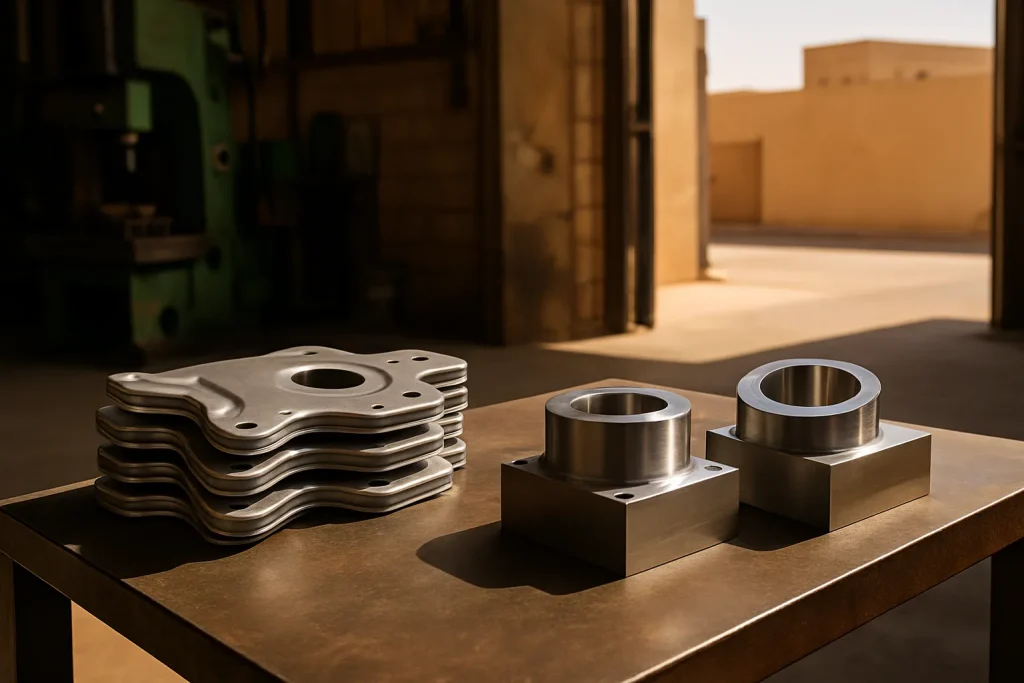
Metal stamping is generally suitable for repeat sheet-metal components with stable designs and production quantities that can justify dedicated tooling. CNC machining is generally more suitable for prototypes, lower quantities, frequent design changes and complex three-dimensional features. The right process depends on the part’s geometry, material, tolerances, production volume, tooling requirements and total manufacturing cost.
For Saudi OEMs and product manufacturers considering component localization, the decision should not be based on production volume alone. Each component requires an engineering and commercial review before selecting the manufacturing route.
This guide compares metal stamping vs CNC machining and explains which factors companies should examine before localizing a component in Saudi Arabia.
What Is the Difference Between Metal Stamping and CNC Machining?
Metal stamping and CNC machining create metal components in fundamentally different ways.
Metal stamping is a forming process. Flat sheet metal is cut, bent, drawn or otherwise formed using a press and dedicated tooling. Depending on the component, the tooling may complete one operation or combine several operations into a controlled production sequence.
CNC machining is a subtractive process. Cutting tools remove material from a block, bar or other workpiece until the required geometry is produced. It can create pockets, threads, holes, internal features and complex three-dimensional forms that may not be practical through sheet-metal forming.
The basic distinction is:
- Metal stamping forms sheet metal with tooling.
- CNC machining removes material from a workpiece.
Neither process is automatically better. The decision should be based on the specific component and its production requirements.
When Is Metal Stamping a Suitable Choice?
Metal stamping may be suitable when a component:
- Is made from sheet metal
- Has a stable and approved design
- Will be ordered repeatedly
- Requires consistent geometry across production batches
- Can be cut, bent or formed using an appropriate tool
- Has expected quantities that may justify tooling investment
- Does not contain features that require extensive material removal
Potential candidates can include suitable brackets, fixing plates, covers, supports, clips and other repeat press-formed components.
Every example must still be reviewed for material, thickness, bends, tolerances, part function and quality requirements. A component that appears visually simple may contain critical dimensions or performance requirements that affect its manufacturing route.
Metal stamping is not automatically appropriate simply because the expected quantity is high. Tooling complexity, material behavior, inspection requirements and the expected production life must also be considered.
For more information about the process, read our guide to how stamped metal parts are made.
When Is CNC Machining a Suitable Choice?
CNC machining may be considered when a component:
- Is required in prototype or limited quantities
- Has a design that is still changing
- Includes complex three-dimensional geometry
- Requires pockets, internal features or machined threads
- Is produced from a solid block or bar
- Requires features that cannot be created practically through stamping
- Does not yet justify dedicated production tooling
Machining can allow engineering teams to test a design before investing in a production tool. It may also remain the appropriate long-term process for parts whose geometry cannot be produced effectively from sheet metal.
However, machining a prototype does not prove that the same design can move directly into stamping. A stamped version may require changes to wall thickness, bends, radii, holes, tolerances or material direction.
Any redesign must be reviewed and approved by the customer’s engineering team.
How Does Production Volume Affect the Decision?
Production volume affects the unit economics of metal stamping and CNC machining, but there is no universal quantity at which stamping automatically becomes less expensive.
CNC machining may require less dedicated tooling at the beginning, but each component requires machine and cutting time. Metal stamping may require a larger initial tooling investment, but that investment can be distributed across repeat production quantities.
The commercial comparison should consider:
- Expected annual demand
- Batch quantities
- Product lifetime
- Tooling cost
- Setup requirements
- CNC programming and cycle time
- Material utilization
- Finishing operations
- Inspection requirements
- Packaging
- Expected engineering changes
A stable part with repeat demand may support investment in stamping tooling. A part with uncertain demand or frequent design changes may remain better suited to machining until its design and requirements become stable.
The correct crossover point must be calculated for each component.
How Does Part Geometry Influence Process Selection?
Part geometry is often more important than quantity.
Metal stamping is commonly considered for parts made from sheet metal with:
- Flat sections
- Holes or cut-outs
- Bends and flanges
- Tabs and fixing features
- Suitable formed sections
- Consistent material thickness
CNC machining can be more suitable for:
- Deep pockets
- Thick solid sections
- Internal threads
- Complex three-dimensional surfaces
- Features that require material removal
- Geometries that cannot be opened or formed using a die
Some components may require more than one process. For example, the main form could potentially be created using sheet-metal operations, while specific features may need an approved secondary process.
Whether this combined route is technically and commercially suitable must be assessed during the manufacturing feasibility review.
How Do Materials Affect Stamping and Machining?
The material must be evaluated according to the selected process and the component’s intended function.
For stamping, important factors include:
- Material grade
- Sheet thickness
- Ductility and formability
- Bend behavior
- Surface condition
- Directional properties
- Risk of cracking or springback
- Finish or coating requirements
For CNC machining, the review may consider:
- Machinability
- Cutting-tool requirements
- Heat generation
- Workholding
- Material removed
- Surface-finish requirements
- Tool wear
A material that is commercially available does not automatically suit every process. Substituting a material to support local production may affect strength, corrosion performance, formability, dimensions or component life.
No material change should be implemented without the required technical review and customer approval.
How Should Tolerances and Quality Be Compared?
It is not accurate to assume that CNC machining always provides the necessary quality or that metal stamping automatically produces identical parts without process control.
Achievable tolerances depend on:
- Component design
- Material and thickness
- Tooling condition
- Production equipment
- Process stability
- Inspection method
- Environmental conditions
- Required surface finish
Before selecting a process, the customer should identify the dimensions and characteristics that are critical to the component’s form, fit or function.
The manufacturer and customer should then agree on:
- Approved drawing revision
- Critical dimensions
- Inspection method
- Sampling requirements
- Material evidence
- Surface acceptance
- Non-conformance procedure
- Sample or pilot approval criteria
ALROUF Industrial does not assume that every metal component is suitable for stamping. The required tolerances and inspection criteria must be reviewed before manufacturing acceptance.
What Role Does Tooling Play in Metal Stamping?
Tooling is a central part of the stamping decision. Depending on the component, it may include a die, fixture, gauge or other production-specific equipment.
The tooling review should determine:
- Whether new tooling is required
- Whether existing tooling can be transferred or modified
- Compatibility with the proposed production process
- Tool ownership
- Maintenance responsibility
- Permitted use
- Modification approval
- Storage and access
- End-of-program arrangements
Tooling costs should be separated from recurring unit prices so the customer can understand the full commercial structure.
There is no standard tooling cost or delivery period suitable for every stamped component. Geometry, number of operations, material, tool complexity, trials and inspection requirements all affect the final quotation and schedule.
Tooling should not be ordered before the drawing, material, expected quantities and acceptance requirements have been reviewed.
Is Metal Stamping Always Cheaper Than CNC Machining?
No. Metal stamping may reduce the recurring unit cost of a suitable repeat component, but the tooling investment and supporting operations must be included in the comparison.
CNC machining may be commercially preferable for:
- Prototype quantities
- Short production programs
- Uncertain demand
- Designs undergoing frequent changes
- Parts that require complex material removal
Metal stamping may become more attractive when:
- The design is stable
- Demand is repeatable
- The geometry suits forming
- Tooling can be used across the expected production program
- Quality requirements can be achieved consistently
A meaningful cost comparison should evaluate the entire production program—not only the quoted price of one component.
How Should Total Landed Cost Be Evaluated?
Total landed cost may include more than the unit manufacturing price.
For imported or locally produced components, companies may need to compare:
- Unit price
- Tooling and setup
- Material cost
- Freight
- Customs and applicable fees
- Inventory requirements
- Packaging
- Inspection
- Rework and non-conformance
- Supply disruption exposure
- Engineering support
- Delivery reliability
Local manufacturing may reduce certain logistics or inventory pressures, but it is not automatically less expensive. The component’s manufacturing economics and supply requirements should be evaluated using real quotations and operational data.
Where applicable, local production may also support a company’s approved local-content objectives. However, eligibility, measurement and procurement benefits depend on the relevant customer or program and should not be assumed.
Can CNC Machining Be Used Before Metal Stamping?
In some development programs, machining can help produce early samples or validate certain features before investment in stamping tooling.
A possible route is:
- Confirm the design requirements
- Produce or evaluate prototypes
- Stabilize the drawing
- Review the design for manufacturability
- Evaluate the stamping route
- Develop and trial appropriate tooling
- Inspect samples
- Obtain customer approval
- Move into repeat production
However, a machined prototype and a stamped production component may behave differently because the manufacturing processes are different. Additional validation may therefore be required after the stamping tool is developed.
How Does Process Selection Support Component Localization?
When localizing an imported component in Saudi Arabia, the objective is to find a production route that is technically suitable, commercially viable and capable of meeting the approved quality requirements.
The localization review should begin with:
- Drawing or detailed part description
- Material and thickness
- Approximate annual demand
- Batch quantities
- Critical tolerances
- Required finish
- Component function
- Inspection requirements
- Existing tooling information
ALROUF Industrial can review suitable repeat metal components for potential stamping or press-forming routes. Parts requiring different processes should be identified during the assessment rather than forced into an unsuitable manufacturing method.
Learn more about industrial localization in Saudi Arabia.
Submit Your Component for Manufacturing Review
Do you have a repeat metal component and need to determine whether stamping may be suitable?
Share the drawing or part description, material, approximate annual demand and quality requirements with ALROUF Industrial. The initial review will identify whether the component may fit a suitable manufacturing route and what information is required for the next technical step.
Submitting a component begins a technical and commercial review. It does not represent automatic manufacturing acceptance, pricing or a delivery commitment.
Submit a Component for Review →
Frequently Asked Questions
What is the difference between metal stamping and CNC machining?
Metal stamping forms sheet metal using a press and dedicated tooling. CNC machining removes material from a workpiece using controlled cutting tools. Stamping is often considered for repeat sheet-metal parts, while machining can suit prototypes, limited quantities and complex three-dimensional geometries.
Is metal stamping cheaper than CNC machining?
It can be more economical for suitable repeat components because tooling costs can be distributed across production quantities. The actual comparison depends on material, geometry, tooling, volume, finishing and inspection.
What production volume makes metal stamping cost-effective?
There is no universal minimum quantity. The crossover point depends on tooling cost, machining time, material utilization, expected annual demand and the intended production life.
Is CNC machining better for prototypes?
CNC machining may suit prototypes and design iterations because it may require less dedicated production tooling. The correct prototyping method still depends on the component and what the sample needs to validate.
Can a machined component be redesigned for stamping?
Potentially. The design may require changes to material thickness, bends, radii, holes, tolerances or other features. Any redesign must be reviewed and approved by the customer’s engineering team.
Does metal stamping require custom tooling?
Most stamped components require suitable tooling or dies. The tooling route depends on the geometry, material, production quantities and required operations.
Is every sheet-metal part suitable for stamping?
No. Suitability depends on geometry, material, thickness, tolerances, component function, tooling, quality requirements and production economics.
How can ALROUF Industrial assess my component?
Begin by sharing a drawing or detailed description, material, thickness, estimated annual quantity, batch size, finish and quality requirements. ALROUF Industrial can then review whether the component may fit a suitable stamping or press-forming route.