
What Should a Contract Manufacturing Agreement Include in Saudi Arabia?
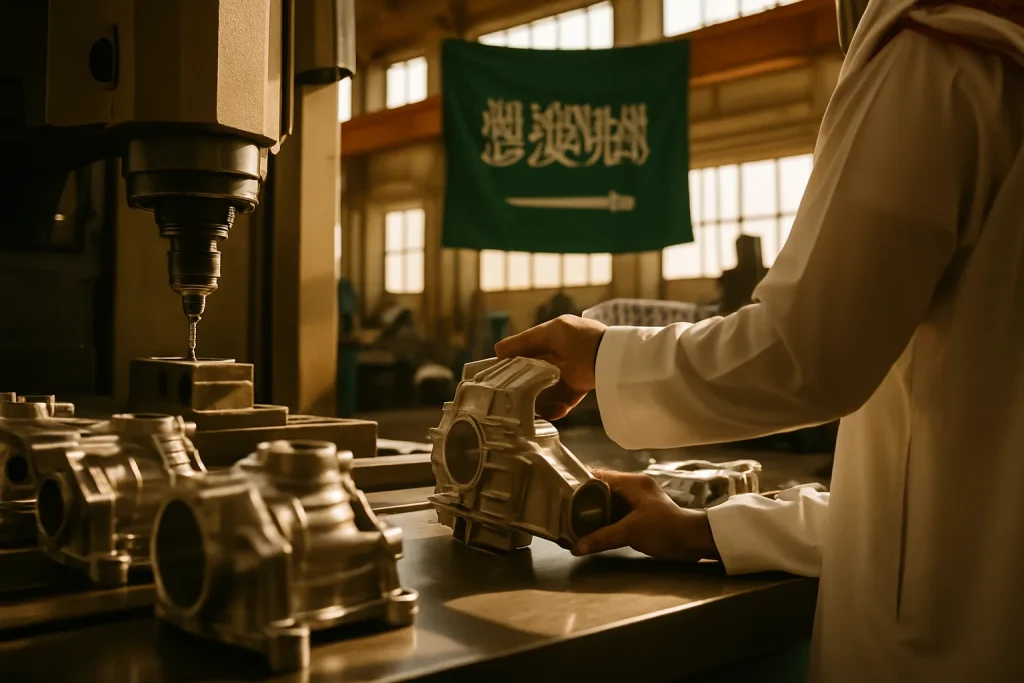
A contract manufacturing agreement in Saudi Arabia should clearly define the components being manufactured, drawing revisions, materials, expected quantities, tooling responsibilities, quality requirements, inspection criteria, delivery terms and change-control process. These elements help the customer and manufacturer move from technical review to sampling and repeat production with clear responsibilities.
For manufacturers localizing imported components or seeking a second production source, the agreement should operate as a practical manufacturing framework—not only as a purchasing document. Its terms must reflect the actual component, production process and commercial arrangement agreed between the parties.
This guide explains the main areas Saudi companies should consider when preparing a contract manufacturing agreement for repeat metal components.
Important: This article provides a general commercial and manufacturing framework. It does not constitute legal advice. Final agreements should be reviewed by qualified legal, commercial and technical representatives.
What Is Contract Manufacturing in Saudi Arabia?
Contract manufacturing is an arrangement in which a company asks a manufacturing partner to produce components according to agreed drawings, specifications and quality requirements.
Unlike purchasing a standard product from a catalogue, contract manufacturing begins with the customer’s own component. The customer may provide:
- An engineering drawing
- A physical sample
- A detailed part description
- Material and dimensional specifications
- Estimated batch and annual quantities
- Quality and inspection requirements
The manufacturer then reviews whether the component fits its processes, tooling, quality controls and available production capacity.
For ALROUF Industrial, the initial focus is on reviewing suitable repeat metal components for potential manufacturing in Saudi Arabia. Submitting a component does not mean it has automatically been accepted for production. Technical and commercial suitability must be evaluated first.
Contract manufacturing can support different business objectives, including:
- Localizing an imported component
- Establishing a second manufacturing source
- Outsourcing a non-core manufacturing process
- Supporting a repeat supply program
- Managing additional production demand
Companies considering localization can also learn more about industrial localization in Saudi Arabia.
How Should the Manufacturing Scope Be Defined?
Scope is one of the most important parts of a contract manufacturing agreement. It identifies exactly what the manufacturer is expected to produce and where each party’s responsibility begins and ends.
The scope should identify:
- Part numbers and descriptions
- Current drawing revision
- Material and material grade
- Dimensions and critical tolerances
- Surface finish or coating
- Estimated annual demand
- Expected batch quantities
- Quality and inspection requirements
- Packaging and labelling
- Delivery location
- Customer approval requirements
The agreement should also explain who will supply the raw material and who will manage any approved external processes or purchased components.
Clear boundaries prevent assumptions. For example, a customer may expect the manufacturer to source material and manage finishing, while the manufacturer may have quoted only for the forming operation. Recording these responsibilities reduces delays and commercial disputes.
The scope should also explain how additional part numbers or variants will be introduced. A minor packaging revision may require a simple documented update, while a new material, dimension or geometry may require another technical review, quotation or sample approval.
What Information Is Needed Before Quotation?
A reliable quotation requires more than a photograph and estimated quantity. The manufacturer needs enough information to understand the manufacturing route, tooling requirements, inspection needs and expected production pattern.
The initial submission should preferably include:
- Part drawing or clear description
- Drawing revision number
- Material and grade
- Thickness and main dimensions
- Critical tolerances
- Required finish
- Component function
- Approximate annual demand
- Batch quantities
- Required delivery location
- Target production date
- Existing tooling information, if applicable
If a drawing contains confidential information, the customer should ask about the available confidentiality process before sharing it.
After receiving the information, the manufacturer may request further details. This is part of qualification and does not represent final manufacturing acceptance.
How Should Tooling Ownership Be Managed?
Tooling may include dies, fixtures, gauges or other production-specific equipment. Tooling ownership and responsibility should be documented before development or production begins.
The agreement should answer:
- Who funds the tooling?
- Who owns it?
- Where will it be stored?
- Who may use it?
- Who is responsible for routine maintenance?
- How will tooling modifications be approved?
- Who pays for changes requested by the customer?
- What happens to the tooling when the agreement ends?
- How will its condition and maintenance history be documented?
Different commercial arrangements are possible. The customer may directly fund and own the tooling, the manufacturer may provide it as part of the production arrangement, or its cost may be recovered through an agreed amortization model.
There is no single structure that fits every component. The correct arrangement depends on the tooling cost, expected production volumes, commercial term and responsibilities accepted by both parties.
Where appropriate, a documented tooling maintenance schedule can clarify maintenance frequency, inspection records and responsibility. Any referenced maintenance process should reflect the actual tooling and approved factory procedures.
How Should Production Capacity Be Addressed?
Capacity should be evaluated against actual production requirements—not only a machine’s nominal specification.
The technical and commercial review should consider:
- Required manufacturing process
- Tooling availability
- Cycle time
- Planned batch quantities
- Demand forecast
- Material availability
- Inspection time
- Maintenance requirements
- Existing factory commitments
- Any approved supporting processes
A contract may use firm orders, committed forecasts and longer-term planning forecasts. However, the duration of each window should be agreed according to the component and supply program rather than copied from a general template.
The agreement should clarify how forecast changes will be communicated and when a forecast becomes a binding order.
If demand increases, both parties should review whether additional shifts, tooling, equipment or inspection resources are needed. The manufacturer should not promise available capacity or delivery dates until the complete requirements and existing production commitments have been reviewed.
What Quality Requirements Should Be Included?
Quality requirements should be linked to the component’s function, drawing and intended application.
Before repeat production, the customer and manufacturer should agree on:
- Critical dimensions
- Inspection method
- Sampling requirements
- Material documentation
- Surface-finish acceptance
- Sample or pilot quantity
- Acceptance criteria
- Non-conformance process
- Corrective-action responsibilities
- Record-retention requirements
Some industries may require a first-article inspection, production trial or formal part-approval process. The appropriate approval method depends on the component, customer requirements and applicable industry standards.
Repeat production should begin only after the sample or pilot has been reviewed and formally approved, followed by an agreed purchase order and supply schedule.
Quality reporting should also be proportionate to the program. The parties may track defect levels, scrap, delivery performance or corrective actions, but metrics should be defined clearly and supported by reliable data.
How Should Engineering Changes Be Controlled?
A change to a drawing, material, thickness, finish, tolerance, tool or manufacturing process can affect cost, quality and delivery. It should therefore be reviewed before implementation.
A change request should identify:
- The proposed change
- The reason for the change
- Affected part numbers
- Updated drawing revision
- Effect on tooling
- Effect on price
- Effect on lead time
- Required inspection or revalidation
- Proposed implementation date
- Responsibility for approval
Customer-requested engineering changes should include updated technical documents. The manufacturer can then evaluate whether new tooling, tool modification, another sample or additional inspection is required.
A manufacturer may also suggest a process or material change to improve manufacturability or support localization. However, it should not implement a change affecting the component’s form, fit, function or specification without the required customer approval.
Only the approved drawing revision should be released for production.
What Commercial Terms Should Be Defined?
Commercial terms should reflect the actual manufacturing program and separate one-time costs from recurring production costs.
The agreement or quotation may define:
- Tooling and setup costs
- Unit pricing
- Material-price adjustment method
- Minimum economical batch quantities
- Packaging costs
- Inspection or testing costs
- Payment terms
- Delivery responsibilities
- Forecast and ordering process
- Warranty or non-conformance responsibilities
- Renewal and termination conditions
Pricing should not be based on annual volume alone. Material, geometry, tolerances, tooling, finishing, inspection, scrap assumptions and packaging can all influence the final cost.
Delivery terms should also identify where responsibility transfers between the manufacturer and customer. Local production may simplify certain supply-chain steps, but the final commercial and logistical benefit must be evaluated for each component.
How Can Contract Manufacturing Support Localization?
Localizing a component means more than moving the same drawing to a Saudi factory. The component must be assessed for:
- Technical manufacturability
- Material availability
- Tooling requirements
- Quality expectations
- Production volume
- Supply continuity
- Inspection and approval
- Commercial viability
A localization review may identify a suitable Saudi manufacturing route, but it may also reveal missing specifications, uneconomical volumes or processes that require additional capability.
The correct approach is to begin with one defined component and evaluate it using evidence. This helps the customer and manufacturer determine whether to proceed to quotation, tooling, sampling or further technical clarification.
From Component Submission to Repeat Production
A controlled contract manufacturing journey can follow these stages:
Inquiry → Qualification → Technical Review → Quotation → Sample or Pilot → Approval → Repeat Order
Each stage should have a responsible owner and a clear condition for progressing.
For example, a quotation should not be issued as a final production commitment if material, tooling or quality requirements remain unresolved. Similarly, a successful sample does not authorize ongoing production without documented approval and a purchase order.
This structured approach helps protect drawing control, quality, capacity and commercial expectations throughout the relationship.
Submit a Component for Manufacturing Review
Do you have a metal component that you currently import, manufacture internally or need from a second source?
Share the part description, approximate annual demand, delivery location and quality requirements with ALROUF Industrial. The team can review the initial information and identify what is required for the next technical and commercial step.
Submitting a part starts a manufacturing review; it does not represent automatic acceptance, pricing or a delivery commitment.
Frequently Asked Questions
What should a contract manufacturing agreement include?
It should define the components, drawings, materials, quantities, tooling responsibilities, quality requirements, inspection criteria, packaging, delivery terms, pricing structure and change-control process. Final terms should be reviewed by the parties’ technical, commercial and legal representatives.
What information is required to review a metal component?
The initial review normally requires a drawing or part description, material, dimensions, estimated annual volume, batch quantity, required finish and quality requirements. Additional information may be requested during the technical review.
Who owns the tooling in contract manufacturing?
Tooling ownership depends on the agreed commercial model. The customer may own it, the manufacturer may provide it, or the cost may be amortized through production. Ownership, maintenance, permitted use and end-of-contract arrangements should be documented.
How is manufacturing capacity confirmed?
Capacity is assessed against the component’s process, tooling, batch size, forecast, inspection needs, material availability and the factory’s existing commitments. Machine specifications alone do not confirm available capacity or delivery dates.
How are samples approved before repeat production?
The customer and manufacturer agree on the sample quantity, inspection method, critical dimensions and acceptance criteria. Repeat production should begin after documented approval and an agreed purchase order.
How are engineering changes managed?
Changes to drawings, materials, dimensions, finishes, tooling or processes should be recorded and reviewed before implementation. Their effect on cost, timing, quality and revalidation should also be evaluated.
How much does contract manufacturing cost in Saudi Arabia?
The cost depends on the material, part geometry, tolerances, tooling, production quantity, finishing, inspection and packaging. A dependable quotation requires a drawing or detailed description and an estimated quantity.
How long does it take to begin contract manufacturing?
The timeline depends on drawing readiness, technical review, material availability, tooling, sampling, inspection and customer approval. A reliable schedule can only be provided after reviewing the component’s complete requirements.
Can an imported metal component be localized in Saudi Arabia?
Potentially, yes. The component must be reviewed for manufacturing suitability, material availability, tooling, quality requirements, production economics and expected quantities before localization is approved.
How can I submit a component to ALROUF Industrial?
Start by sharing a part description, approximate annual demand, delivery location and quality requirements. If the drawing is confidential, ask about the available confidentiality process before uploading it.